Barjeel Fashion
China Top 10 Minimalist Wardrobe Makers: How to Build One? explores a practical route toward fewer, better professional clothes. The guide examines ten Chinese makers through fabric quality, pattern accuracy, stitching, ethical production, customization, and after-sales support. These details matter when a blazer must survive daily commutes, repeated pressing, and long meetings.
Anuschka Rees, wardrobe consultant and author of The Curated Closet, says, “A good wardrobe is not about having a lot of clothes; it’s about having the right clothes.” Her principle supports a useful question: how to build a minimalist professional wardrobe without making it dull or fragile. Start with a restrained palette, such as navy, charcoal, ivory, and one accent color. Add versatile pieces, including a structured jacket, two breathable shirts, tailored trousers, a knit layer, and comfortable formal shoes. Check shoulder seams, button security, lining quality, and fabric recovery before ordering. Ask makers about measurement charts, sample revisions, fiber content, and repair options.
My first capsule wardrobe was too ambitious. I bought similar black trousers and ignored seasonal comfort. That mistake taught me to track actual wear, not imagined outfits. A wardrobe should serve real mornings. It should also leave room for personal style, weather changes, and occasional imperfection. This introduction compares promising Chinese makers while encouraging careful testing, honest reviews, and gradual buying. Building less can still require more thought.
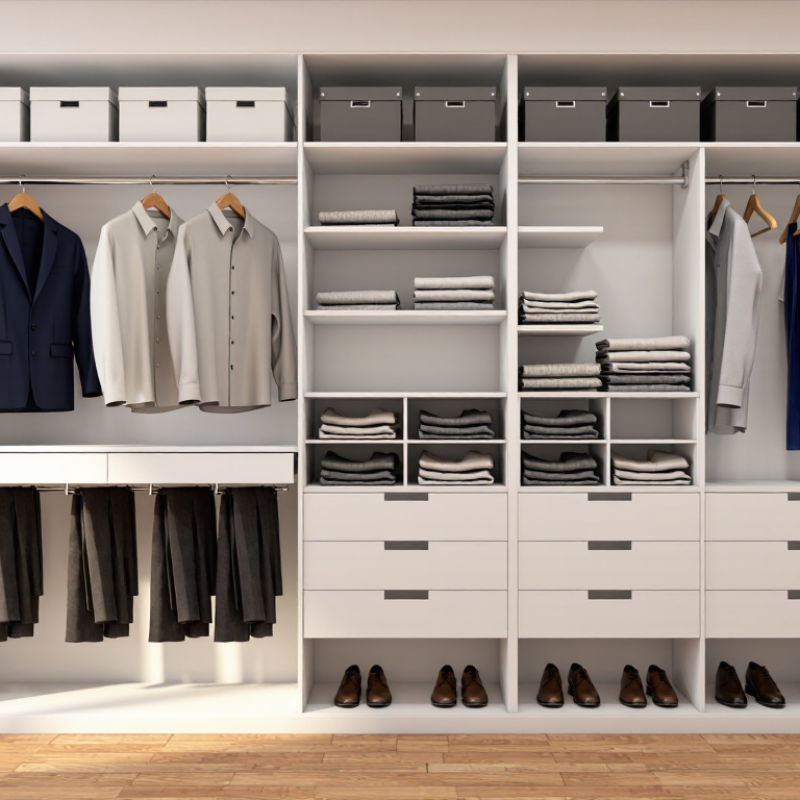
China Top 10 Minimalist Wardrobe Makers: How to Build One?
A reliable ranking needs measurable evidence, not attractive showroom photos. GB/T 39600-2021 should guide evaluation of formaldehyde emission from wood-based panels and related products. Ask for current test reports, declared emission levels, and matching sample details. Documents without traceability deserve less trust. I would assign 30% to material safety, 30% to structural performance, 20% to design flexibility, and 20% to service.
ISO 7170 helps assess storage furniture strength, durability, and stability during repeated use. A wardrobe should survive loaded shelves, sliding doors, and daily opening cycles. EN 14749 adds important safety requirements for domestic storage furniture, especially stability and safe use. Check whether testing covers the actual cabinet construction, not only a similar model. Small details matter, such as edge finishing, hinge adjustment, ventilation gaps, and wall-fixing instructions.
Service separates a dependable maker from a merely capable factory. Evaluate technical drawings, sample approval, packaging protection, installation guidance, spare parts, and warranty response. Request photographs of packed units and a clear replacement process. Delays happen. Honest communication matters more than perfect promises. I would also test one sample before ranking a supplier highly, because a neat sample may conceal inconsistent batch quality. That weakness should remain visible in the scoring.
A standards-based evaluation framework for minimalist wardrobe construction. The ranking model uses product safety, structural performance, material emissions, usability, and after-sales service rather than company or brand data.
How to build the wardrobe: prioritize stable installation and structural strength first, select low-emission board materials, verify door and drawer durability, then complete the design with efficient storage planning, precise installation, warranty coverage, and responsive maintenance. The percentages are editorial weighting criteria, not company performance scores.
China’s top ten minimalist wardrobe makers differ sharply in materials, construction, and production capacity. Some specialize in engineered wood with matte laminate surfaces, while others use plywood, aluminum frames, or glass panels. Engineered wood is economical and consistent. Plywood usually offers better screw strength and moisture resistance. Solid wood feels warmer, but it costs more and may expand with humidity.
Capacity also changes the buying experience. Smaller workshops often customize dimensions carefully, but their monthly output may be limited. Larger factories can produce hundreds of units, maintain stable hardware supply, and support repeat orders. However, high capacity does not always mean better workmanship. Inspect edge sealing, panel thickness, drawer alignment, and packaging through physical samples. Request production photos, material test reports, and a clear quality-control process. A factory should explain its minimum order quantity and realistic lead time without vague promises.
Tips: Build a comparison sheet for all ten makers. Record board type, thickness, finish, hardware grade, monthly capacity, sample cost, and replacement policy. Test one wardrobe before ordering a full batch. Check how the doors move after repeated opening. Small details matter. I once underestimated installation space, and the final unit looked clean but felt cramped. Leave room for ventilation, lighting, and future storage changes. A minimalist wardrobe should reduce visual noise, not reduce daily comfort.
| Rank | Manufacturer Profile | Core Materials | Typical Board Thickness | Annual Capacity | Production Strength | Customization | Best Fit |
|---|---|---|---|---|---|---|---|
| 01 | Profile A | E1/E0 MDF, plywood, melamine laminate, powder-coated steel | 16–25 mm carcass; 5–9 mm back panel | 20,000–50,000 sets | High-volume panel processing and CNC cutting | High; finishes, layouts, hardware, packaging | Large residential and apartment projects |
| 02 | Profile B | MDF, particleboard, PVC edge banding, aluminum profiles | 18–25 mm panels; 8–10 mm doors | 15,000–35,000 sets | Efficient flat-pack and knock-down production | High; modular dimensions and color matching | Retail programs and space-saving wardrobes |
| 03 | Profile C | Natural veneer plywood, solid wood accents, water-based coating | 18–22 mm main panels; 6–8 mm backs | 5,000–12,000 sets | Small-batch craftsmanship and detailed finishing | Very high; veneer, stains, sizes, internal fittings | Premium residential interiors and boutique hotels |
| 04 | Profile D | Melamine-faced particleboard, MDF, anodized aluminum | 16–18 mm carcass; 18–25 mm shelves | 25,000–60,000 sets | Automated drilling, edge banding, and packing | Medium to high; standardized modular systems | Cost-sensitive housing and multi-unit developments |
| 05 | Profile E | E0 MDF, lacquered panels, tempered glass, stainless steel | 18–25 mm panels; 6–10 mm glass | 8,000–20,000 sets | High-gloss, matte lacquer, and handleless door systems | High; door styles, lighting, glass, accessories | Contemporary homes and premium showrooms |
| 06 | Profile F | Bamboo plywood, MDF, rattan panels, low-VOC finishes | 15–20 mm panels; 5–8 mm backs | 3,000–10,000 sets | Sustainable material sourcing and artisan assembly | High; natural textures, stains, and handmade details | Eco-conscious residential and hospitality projects |
| 07 | Profile G | Powder-coated steel, aluminum, engineered wood panels | 0.8–1.2 mm metal; 16–18 mm wood panels | 10,000–30,000 sets | Metal-frame wardrobes and slim-profile systems | Medium to high; frame colors and storage modules | Industrial-style interiors and compact apartments |
| 08 | Profile H | PVC-coated MDF, melamine board, aluminum sliding tracks | 16–18 mm carcass; 8–10 mm door infill | 18,000–45,000 sets | Sliding-door systems and volume-oriented assembly | Medium; standard finishes and configurable interiors | Mass residential developments and export orders |
| 09 | Profile I | Oak or ash veneer, plywood, solid wood edging, matte lacquer | 18–25 mm panels; 6–9 mm backs | 4,000–15,000 sets | Natural-wood matching and premium surface control | Very high; dimensions, grain direction, and interiors | High-end homes and design-led commercial spaces |
| 10 | Profile J | Particleboard, MDF, HPL laminate, ABS edge banding | 16–18 mm carcass; 8–18 mm doors | 12,000–28,000 sets | Flexible OEM production and short-to-medium runs | High; private-label packaging and mixed specifications | Online furniture sellers and international distributors |
A 600-mm-deep wardrobe is a practical starting point for a minimalist bedroom.
It usually accommodates hanging clothes on standard hangers, while keeping the room from feeling crowded. Measure the finished wall, skirting boards, doors, and floor slope before ordering. A few millimeters matter.
The 32-mm modular spacing system gives the cabinet a repeatable structure. Set vertical holes every 32 mm for adjustable shelves, drawers, and hanging rails.
For example, a 640-mm internal bay can hold twenty spacing intervals. Keep shelves around 300 to 350 mm apart for folded shirts.
Leave about 950 mm for short garments and 1,600 mm for coats or dresses. Check panel thickness, because a 600-mm outside depth may provide less usable space inside.
When comparing Chinese minimalist wardrobe makers, ask for technical drawings, edge-sealing details, load ratings, and installation instructions.
Request a physical sample of the board and finish. I prefer adjustable legs and removable back panels because uneven floors are common in real homes. Soft-close hardware is useful, but it should not replace accurate alignment.
Small details change daily use. Add warm internal lighting, concealed cable routes, and a shallow tray for watches or keys.
Avoid filling every bay. Empty space helps air circulate and makes future changes easier.
The plan will not be perfect. I once allowed too little clearance beside a drawer, and the handle marked the wall. Measure twice.
A minimalist wardrobe begins with accurate measurement, not a glossy drawing. Record wall width, ceiling height, skirting depth, sockets, switches, and door swing. Check uneven floors with a laser level, because small errors create visible gaps later. Count shirts, coats, shoes, and folded items in regular use. This list guides shelf spacing, hanging zones, drawers, and ventilation. Leave service access for lighting and future adjustments. I once planned generous shelves that looked elegant but wasted daily space. That mistake still matters.
After measurement, create a scaled model showing panels, doors, hardware, and internal clearances. Open every door in the model. Check collisions. A reliable manufacturer should confirm board thickness, edge treatment, hardware load ratings, and finish samples before production. Request shop drawings, production tolerances, and a documented delivery schedule. During manufacture, inspect color consistency, drilling accuracy, edge quality, and drawer movement. Photos help, but physical samples reveal more.
Delivery requires careful protection around corners, floors, and stairways. Confirm package labels before unloading. Installation should follow the approved drawings, with level checks at every cabinet run. Secure tall units properly, especially in homes with children. Test hinges, drawers, lighting channels, and ventilation gaps before accepting the work. Keep a written defect list. Small corrections are easier before final payment, although rushed schedules can still cause avoidable compromises. A thoughtful maker listens, records changes, and explains what cannot be achieved within the chosen budget.
China’s Top 10 Minimalist Wardrobe Makers: How to Build One?
A clean wardrobe begins with a disciplined quality audit, not attractive renderings. Request an independent emissions report for every board type. The target should be E1 ≤0.124 mg/m³, verified by a recent laboratory document. Check the test method, sample number, and production date. A certificate without traceable details proves little. Open the doors indoors. A sharp chemical smell deserves further testing.
Hardware needs practical inspection. Ask for hinge cycle data and tested drawer loads. A 30-kilogram shelf should not sag under folded coats and shoes. Check wall anchors, back panels, runners, and screw depth. Pull handles firmly. Small weaknesses become expensive after daily use. I once saw a beautiful unit fail because its thin back panel carried the whole structure. Looks can mislead.
Fit is equally important. Measure wall width, ceiling height, skirting boards, sockets, and floor level. Leave service gaps where uneven walls require them. Confirm the installation drawing before production. Warranty terms need equal attention. Look for written coverage periods, replacement-part policies, labor responsibility, and exclusions for moisture or poor installation. Some terms sound generous but cover only hardware. That is a detail worth questioning. Recheck everything before signing.
It usually fits standard clothes hangers without making the room feel crowded. Check the finished wall, skirting boards, doors, and floor slope before ordering. A few millimeters matter.
Vertical holes repeat every 32 mm for shelves, drawers, and hanging rails. A 640-mm internal bay provides twenty spacing intervals. Adjustable parts support future changes.
Keep folded-shirt shelves about 300 to 350 mm apart. Allow around 950 mm for short garments. Coats and dresses need roughly 1,600 mm.
Request technical drawings, board samples, edge-sealing details, load ratings, and installation instructions. Ask for a recent, traceable emissions report. It should verify E1 at or below 0.124 mg/m³.
Ask for hinge-cycle data and tested drawer loads. A 30-kilogram shelf should support folded coats and shoes without sagging. Pull the handles firmly. Small weaknesses grow expensive.
Measure wall width, ceiling height, sockets, skirting boards, and floor level. Confirm the installation drawing before production. Leave service gaps beside uneven walls.
Warm internal lighting helps locate dark clothing. Concealed cable routes keep wiring tidy. A shallow tray can hold watches or keys. Do not fill every bay.
Look for coverage periods, replacement-part policies, labor responsibility, and installation exclusions. Confirm whether moisture damage is excluded. Attractive wording can hide narrow protection.
Yes. I once allowed too little drawer clearance, and the handle marked the wall. Measure twice, then review nearby doors and walls again. Perfect plans are uncommon.
This guide explains how to build a minimalist professional wardrobe through a structured, quality-focused process. It establishes ranking criteria based on GB/T 39600-2021, ISO 7170, EN 14749, material performance, production capacity, customization, delivery, installation, and after-sales service. The comparison focuses on practical factors such as board quality, environmental performance, storage flexibility, structural durability, and manufacturing consistency, without relying on brand names.
For planning, a 600-mm-deep wardrobe with 32-mm modular spacing provides a balanced foundation for hanging clothes, shelves, drawers, and accessories. The recommended workflow covers accurate measurement, digital modeling, production confirmation, delivery inspection, and professional installation. Final quality audits should verify E1 emissions of no more than 0.124 mg/m³, hardware load performance, panel alignment, door fitting, surface finishing, and clear warranty terms. By combining disciplined design, tested materials, precise manufacturing, and careful installation, homeowners can create an organized, durable, and visually calm wardrobe system suited to long-term professional use.